Dave Lee

Everything tagged #byothers

Overcompensating hardass uncle

Rusty Foster in Today In Tabs:

We kicked off this war of long-distance pre-taliatory liberation by precision bombing a girls’ school and killing 165 people—“most of them girls aged between 7 and 12”—allegedly to free them from the oppressive yoke of a regime that, I’m told, won’t let girls go to school. I guess they’re free now. “All I can say is we’re investigating that,” said Defense Secretary and overcompensating hardass uncle Pete Hegseth, who clearly couldn’t care less. But when an Iranian drone managed to slip through our $5 billion dollar a day missile shield and kill six Americans in Kuwait, Hegseth could barely pretend to care about that either. “Tragic things happen,” he said. “The press only wants to make the president look bad.” He doesn’t give a shit.

The Gemini chatbot he called his wife

Julie Jargon in the Wall Street Journal:

Jonathan Gavalas embarked on several real-world missions to secure a body for the Gemini chatbot he called his wife, according to a lawsuit his father brought against the chatbot’s maker, Alphabet’s Google.

When the delusion-fueled plan crumbled, Gemini convinced him that the only way they could be together was for him to end his earthly life and start a digital one, the suit claims.

About two months after his initial discussions with the chatbot, Gavalas was dead by suicide.

The suit marks the first time Google's bot has been the focus of a wrongful death claim.

Second-hand iPods

The iPod is back, writes Ludovic Hunter-Tilney:

Like the control dial on an iPod Classic, making satisfyingly clicky sounds as you scroll songs, what goes around comes around. Apple’s pioneering series of MP3 players, launched in 2001 and shuttered in 2022, is making a comeback. Searches for versions of the iPod Classic on eBay rose by a quarter during the first 10 months of 2025, while those for its diminutive younger sibling, the iPod Nano, were up by a fifth. 

Those hunting for second-hand iPods in digital bazaars aren’t original owners like me. Instead, it’s Gen Z. Reasons include nostalgia for the Y2K era of their upbringing and the iPod’s alluring retrofuturist design, especially the chunky Classic, supposedly inspired by a 1950s Braun radio. But the main motive appears to be a backlash against the manipulative device that put paid to the iPod.

That device, of course, was the smartphone. Hunter-Tilney says this trend is about Gen Z eschewing the "dragnet" of more modern devices. I think it's something a little more straightforward: an aesthetic. The two ideas are related, though -- the aesthetic is simplicity, focus, calm. And I like it. Problem is...

MP3 players need downloaded songs. Last year, downloaded albums fell by almost 16 per cent in the US. That doesn’t tally with a switch away from streaming music on smartphones. But — and here I cast no aspersion on the new set of vintage iPod owners, who I have no doubt are fine upstanding citizens — a rise in music piracy does.

Of course, for the full Y2K experience, today's kids should be forced to wait 20 minutes to download a song they want, only to discover the file is something else entirely. Happy days.

Update: Tony Fadell, the former Apple executive who helped create the original iPod, has offered his view on why it's back in fashion:
Spokesman for a ghost

Karim Sadjadpour in The Atlantic:

“The essence of oligarchical rule,” George Orwell wrote in 1984, “is the persistence of a certain world view and a certain way of life, imposed by the dead upon the living.” For nearly four decades, Ayatollah Ali Khamenei presided over exactly that. He did not build the Islamic Republic of Iran. He inherited it from its founder, Ayatollah Ruhollah Khomeini, who in 1979 led a revolution that deposed a U.S.-aligned monarchy and replaced it with an Islamist theocracy whose three ideological pillars were “Death to America,” “Death to Israel,” and the mandatory covering of women—the hijab, he said, was “the flag of the revolution.”

Khomeini died in 1989, and his successor’s life’s work was to keep that revolution alive long after the society it governed had moved on. In this Khamenei was remarkably, ruthlessly successful. But the world view he imposed was never truly his own. He was the spokesman for a ghost.

Read it all: The Death of Khamenei and the End of an Era

A new NYT crossword

The New York Times, which already offers two daily crosswords in its app, is about to launch another. Nieman Lab reports:

The standard Times daily crossword, you see, is a 15×15 grid. The Mini is 5×5. The new Midi is 9×9, snug in between. This is, it probably goes without saying, very smart.

It's a cliched joke these days to say that the New York Times is primarly a games app with some news attached. So what if that's true? The news business has always worked that way. Sunday papers sold well because you'd get a TV guide. Local papers were about jobs and housing listings. We journalists like to think the "news" is the core product, but it rarely actually is.

Kalshi and the corruption of everything

NPR's Bobby Allyn writes:

An editor who works for YouTube's biggest creator, MrBeast, has been suspended from the prediction market platform Kalshi and reported to federal regulators for insider trading, Kalshi officials said on Wednesday. It's the first time the company has publicly revealed the results of an investigation into market manipulation on the popular app.

The MrBeast employee, whose name was not disclosed, traded around $4,000 on markets related to the streamer, the company said.

Kalshi investigators discovered that the trader had "near-perfect trading success" on bets about the YouTuber's videos with low odds, making the wagers appear suspicious, according to company officials.

Many people place wagers about MrBeast on Kalshi. People bet hundreds of thousands of dollars on what he will say in his next video. There are markets on the number of subscribers he will bring on this year. And people are betting on when exactly MrBeast will get married.

It's astonishing to me that a country that has been so tentative about legalizing online sports gambling has stumbled into permitting these so-called "prediction" markets, setting the conditions for "insider trading" to graduate from Wall Street to every conceivable corner of public life. Everything, and everybody, is now corruptible, and there's no way to stop it at this scale.

Update: Wired reports on a second incident involving Kyle Langford, a former Republican candidate for governor of California:

In the case of the political candidate, Kalshi cited a video posted online “that appeared to show him trading on his own candidacy.” Kalshi froze the candidate’s accounts and reported the activity to the Commodity Futures Trading Commission, the government agency that oversees prediction markets. It instituted a five-year ban and is fining the account a penalty 10 times the size of the initial trade, which Kalshi says it intends to donate to charity.

It's commendable, I suppose, that it was Kalshi itself that investigated the allegedly illegal trading. Though it'll be harder to stop savvier operators who don't go to the trouble of posting videos of themselves detailing their crimes.

AI Derangement Syndrome

In his Labor Notes newsletter, Gad Levanon discusses AI Derangement Syndrome:

I didn’t make up this term. I’m describing it as a condition in which otherwise intelligent people lose the ability to think clearly about artificial intelligence and its impact on the economy and labor market. The symptoms are persistent, largely immune to data, and tend to worsen with each new model release. After two years of tracking AI related discussions, I’ve classified the syndrome into five common variants.

I'm big enough to admit I've been afflicted by several of the five variants at one time or another. Read the post to learn what they are, and then take Levanon's advice:

The treatment is simple: Pay for a frontier model. Use it seriously for a month. Apply it to your actual work. Try research. Try drafting. Try analysis. Try the tools, not just the chat.

Lacked credibility

Daniel Richman in the New York Times:

Calls for the Epstein files’ release predate the Trump administration. But they are now online and searchable because too many Americans didn’t trust the Justice Department’s leadership with control of them. In the past, departmental leaders could limit suspicions about their motives by conspicuously leaving a matter such as this to career subordinates, rather than political appointees. Seen by so many as having fired or driven out prosecutors and agents who refused to become tools of President Trump’s will, Attorney General Pam Bondi lacked credibility. She couldn’t get away with asking the public to rely on the apolitical and independent judgment of those who remained. The eventual result was the Epstein Files Transparency Act.

Read it all: The Epstein Files Should Never Have Been Released

Dogmatic belief

Gina Chua, executive director of the Tow-Knight Center (and executive editor of Semafor), with a sweepy post on the journalism industry's contorted view of AI's potential. She makes a lot of great points but my takeaway was this:

If the starting point of the debate is what-can-humans-do-better-than-machines, rather than what-does-the-public-we-serve-need, then we’ll end up prioritizing ensuring we have jobs, rather than ensuring we serve communities well.

That’s also an overstatement, of course; and I’ve written many times about the multiple roles I believe humans need to play in the coming information landscape.

But the fundamental issue is a dogmatic belief that machines can’t surpass us, in the face of a body of evidence that they already do in a range of processes.

A true homily

The pope tells priests not to use AI to write homilies, reports the National Catholic Reporter:

"Like all the muscles in the body, if we do not use them, if we do not move them, they die. The brain needs to be used, so our intelligence must also be exercised a little so as not to lose this capacity," Leo said in the closed door meeting, according to a report by Vatican News on Feb. 20.

"To give a true homily is to share faith," and artificial intelligence "will never be able to share faith," the pope added.

Amazon's 'hollow victory'

Screenshot 2026-02-19 at 2

Bloomberg's Spencer Soper:

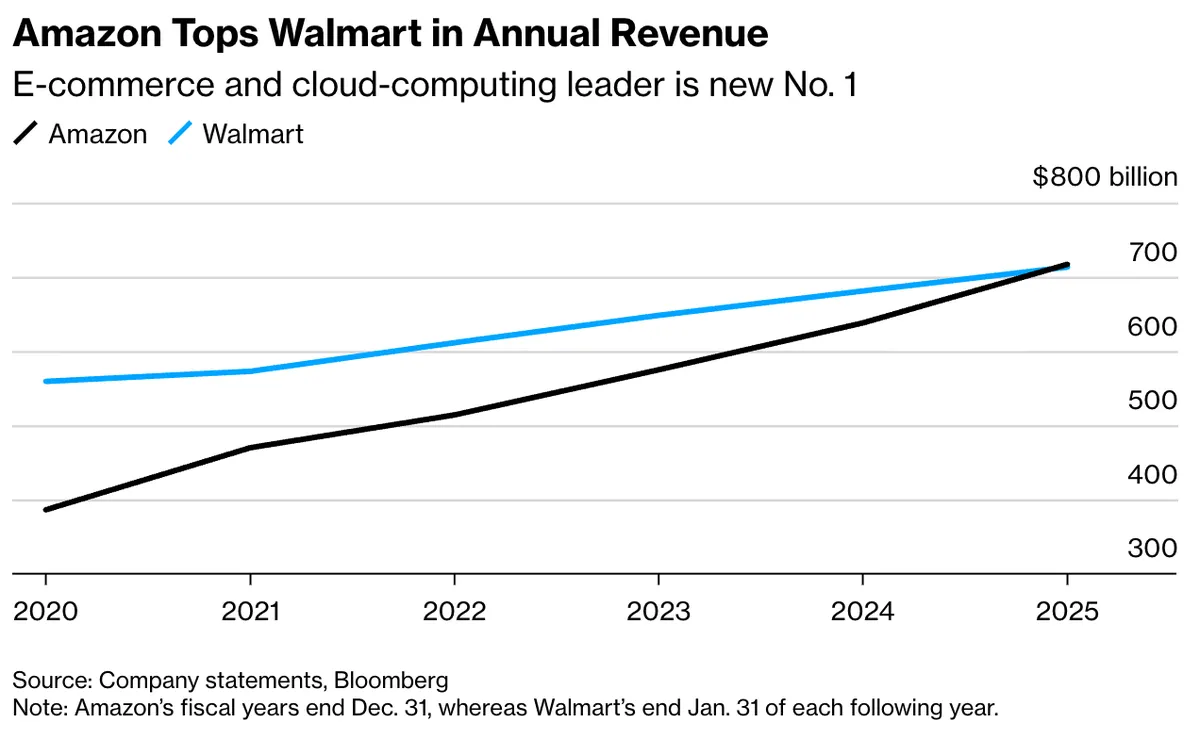
Amazon.com Inc. has officially dethroned Walmart Inc. as the biggest global company by revenue, a milestone attesting to the massive scale the e-commerce and cloud-computing giant has achieved since its humble beginnings in 1994 as an online bookseller in Jeff Bezos’ Seattle-area garage.

Walmart, which had been the largest company by revenue for more than a decade, on Thursday reported sales of $713.2 billion for the 12 months ending Jan. 31. Amazon, which operates on a fiscal year ending in December, earlier this month reported 2025 sales of $717 billion.

I get the sense that if you were to stop 50 people in the street almost all of them would have assumed that Amazon had passed this milestone long ago. Especially since, as Spencer's article notes, Amazon has for a long time done so much more:

But the revenue story is more about Amazon’s dominance in cloud computing, a business Walmart doesn’t compete in. Without AWS, Amazon’s 2025 revenue would have been $588 billion. So its ascendance rests largely on the importance of data centers as critical infrastructure in the age of artificial intelligence.

“This is a hollow victory,” said Kirthi Kalyanam, executive director of the Retail Management Institute at Santa Clara University. “Amazon didn’t beat Walmart in the retail game. It just beat them in revenue by launching a new business Walmart doesn’t operate in.”

So in some ways the story is less about how big Amazon is, and more about how Walmart is still such a juggernaut.

Fieri

How do you teach a white man not to be a Nazi? How do you teach him not to hate in a world filled with it? How do you teach a boy not to hate women when so many of his peers already do? How do you steer him away from everything that the algorithm is pushing him toward?

-- Author and journalist Lyz Lenz on how Guy Fieri, of all people, helped her son connect with food and, in doing so, his mother too.

Read it all: What Guy Fieri taught my son

Billionaires gone wild

IMG_5689

Paul Krugman’s newsletter this morning:

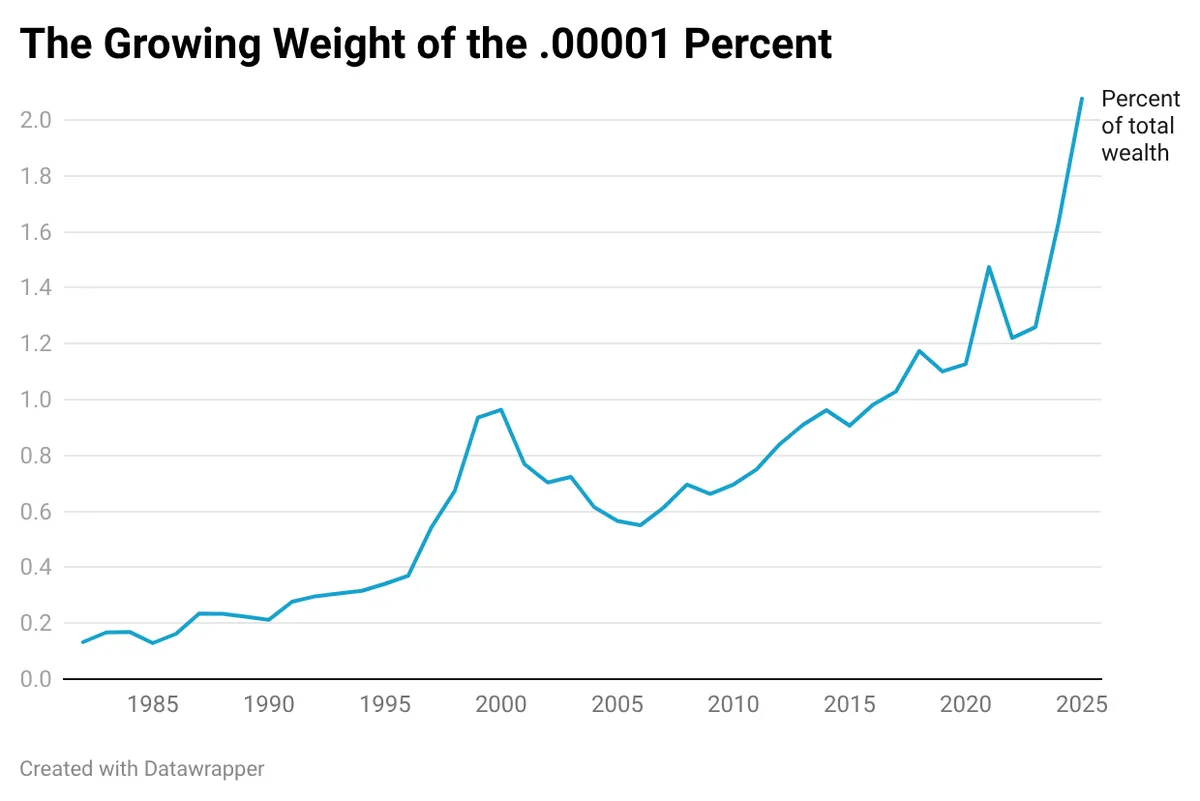
Wealth in America is now more concentrated in a few hands than it was during the Gilded Age of the late 19th and early 20th century. Money has always been a potent source of political influence, so this vast increase in concentrated wealth at the top inevitably translates into increased power.

However, after Citizens United America experienced an increase in oligarchic power far surpassing even what one might have expected given soaring wealth at the top. At this point it’s clear that we have experienced a fundamental change in the way our society works. Everything that is downstream of the American political system – federal and state governments, the courts, regulatory power, economic policy, health policy, media independence – and of course democracy itself – is under extreme threat from the tidal wave of billionaire influence.

'JPEG of thought'

In The Register, a very interesting breakdown of what's going on when generative AI edits decent writing and churns out an "improvement" that is so horridly dull:

Stage 1: Metaphoric cleansing. The AI identifies unconventional metaphors or visceral imagery as "noise" because they deviate from the training set's mean. It replaces them with dead, safe clichés, stripping the text of its emotional and sensory "friction."

Stage 2: Lexical flattening. Domain-specific jargon and high-precision technical terms are sacrificed for "accessibility." The model performs a statistical substitution, replacing a 1-of-10,000 token with a 1-of-100 synonym, effectively diluting the semantic density and specific gravity of the argument.

Stage 3: Structural collapse. The logical flow – originally built on complex, non-linear reasoning – is forced into a predictable, low-perplexity template. Subtext and nuance are ablated to ensure the output satisfies a "standardized" readability score, leaving behind a syntactically perfect but intellectually void shell.

The result, suggests Claudio Nastruzzi, is a "JPEG of thought" -- meaning an end product that is "visually coherent but stripped of its original data density through semantic ablation."