Count Binface, in announcing he will run in the farcical Clacton by-election against Nigel Farage, makes a compelling pitch to voters on the BBC's Today programme:
Everything tagged #politics
Another UK department abandons X/Twitter. It’s the right decision but a sad one: There was a time when government ministers joining Twitter was a win for accountability. Now these figures must leave in the name of decency.
 Lisa Nandy removing herself and DCMS from Twitter would have been unthinkable a few years ago but honestly the only mad thing is that it hasn’t happened sooner. And now it’s pretty hard for a future… | Jim Waterson | 49 commentslnkd.inLisa Nandy removing herself and DCMS from Twitter would have been unthinkable a few years ago but honestly the only mad thing is that it hasn’t happened sooner. And now it’s pretty hard for a future DCMS secretary to actively reinstate the department. Plus it’s a question for every other minister now.
Westminster and journalism still runs on X but honestly if there was a mass migration elsewhere (to, idk, platforms where the general public consume stuff) it would probably be healthier for society. And if you’re a reporter worried from a journalism perspective, since I stopped consuming and mentally writing for Twitter I’ve massively increased my audience. | 49 comments on LinkedIn
Lisa Nandy removing herself and DCMS from Twitter would have been unthinkable a few years ago but honestly the only mad thing is that it hasn’t happened sooner. And now it’s pretty hard for a future… | Jim Waterson | 49 commentslnkd.inLisa Nandy removing herself and DCMS from Twitter would have been unthinkable a few years ago but honestly the only mad thing is that it hasn’t happened sooner. And now it’s pretty hard for a future DCMS secretary to actively reinstate the department. Plus it’s a question for every other minister now.
Westminster and journalism still runs on X but honestly if there was a mass migration elsewhere (to, idk, platforms where the general public consume stuff) it would probably be healthier for society. And if you’re a reporter worried from a journalism perspective, since I stopped consuming and mentally writing for Twitter I’ve massively increased my audience. | 49 comments on LinkedInWhat role for Britain in the AI revolution? Kanishka Narayan, the UK’s minister for AI and Online Safety, does a great job outlining both the country's vulnerability — no frontier LLMs to call its own — and its strength: more than a century of computing and AI innovation. Speaking to the Financial Times:
I think that the diagnosis has to be that we are not in a terrific position from a strategic leverage point of view. The frontier models are developed either in the United States or slightly behind them by a few months in China. And so Britain does not have companies when it comes to frontier language models, and we don’t have the core chip architecture, the Nvidia chips, as well as the memory and packaging.
So SK Hynix in South Korea, for example, gives them an advantage. TSMC in Taiwan gives them an advantage. ASML in Netherlands gives them an advantage. And so broadly speaking, we have some strengths in that supply chain, but none of those you would point to. Arm does a lot of the chip design, but none of those you’d really point to and say Britain is currently competing sufficiently with the United States and China so that we can have continued access to critical inputs.
And so the nature of the problem is very stark, and I think it’s a serious question for the future of our economic and national security. And so what do you do about it? And there are two ways I think about this. Broadly, what you’re trying to do is have, without the pun, chips on the table so that you can access others as critical inputs.
And you can do that either by having chips on the table in the AI stack, or you can also think about it as a broader international negotiation bundle. We might not just offer AI things, we might offer other things that are important to, say, the United States or to China to be able to secure access. On AI, what we’re trying to do is effectively say we think it’s really critical we build more leverage, and that’s why we are focused on things that give us leverage.
We think our chip companies will, if they succeed, be in a position where it’s very hard to replace them in some cases, and that gives you leverage. We think some of the frontier models that we’re developing outside of language in materials discovery, in new drugs discovery, in world models and vision models, we think those will give us leverage. But those are not overnight things, and they take a little bit of time.
And the third thing is, we have built pretty remarkable state capacity. We have built the AI Security Institute, which is the only lab in the world that gets pre-deployment access to all the core models. And so by understanding the risks, sharing it in a trusted way with core allies across the Five Eyes, we think we’re able to build trust that also gives us leverage in the AI stack as well.
And so my focus across the AI stack, both on hardware, on models, and at the heart of it on governance assurance, on safety, on state capacity, is to try and build things that serve British interests domestically as well as internationally.
 Transcript: How to win at AI (if you’re not the US or China), with AI minister Kanishka Narayanft.comSoumaya Keynes speaks to Kanishka Narayan
We were either too racist or not racist enough.
 I saw all Reform’s weaknesses on display in Makerfield – Farage should be worried | John Harristheguardian.comFrom a hopeless candidate to botched strategy, this latest byelection defeat is telling. But for Labour, there is still a long and arduous journey ahead, says Guardian columnist John Harris
Elon Musk will for sure rant and rave, but he can be ignored: Richard Hermer has become the first UK cabinet minister to order his department — the Attorney General's Office — to leave X. The Observer reports:
Hermer’s decision, communicated to staff via a directive last week, comes off after a surge in mis- and disinformation in relation to the murder of Henry Nowak and the brutal knife attack in Belfast. The attorney general is said to be increasingly concerned about how X in particular is being used by bad actors to attempt to divide communities in the UK. In both cases, the platform was used by far-right activists including Robinson (real name Stephen Yaxley-Lennon) to coordinate protests, which in some cases led to riots.
High-profile politicians including Robert Jenrick shared doctored images from bodycam footage in the Nowak case, while Grok wrongly identified two former police officers as being among those attending the scene, resulting in details about the individuals being widely shared online.
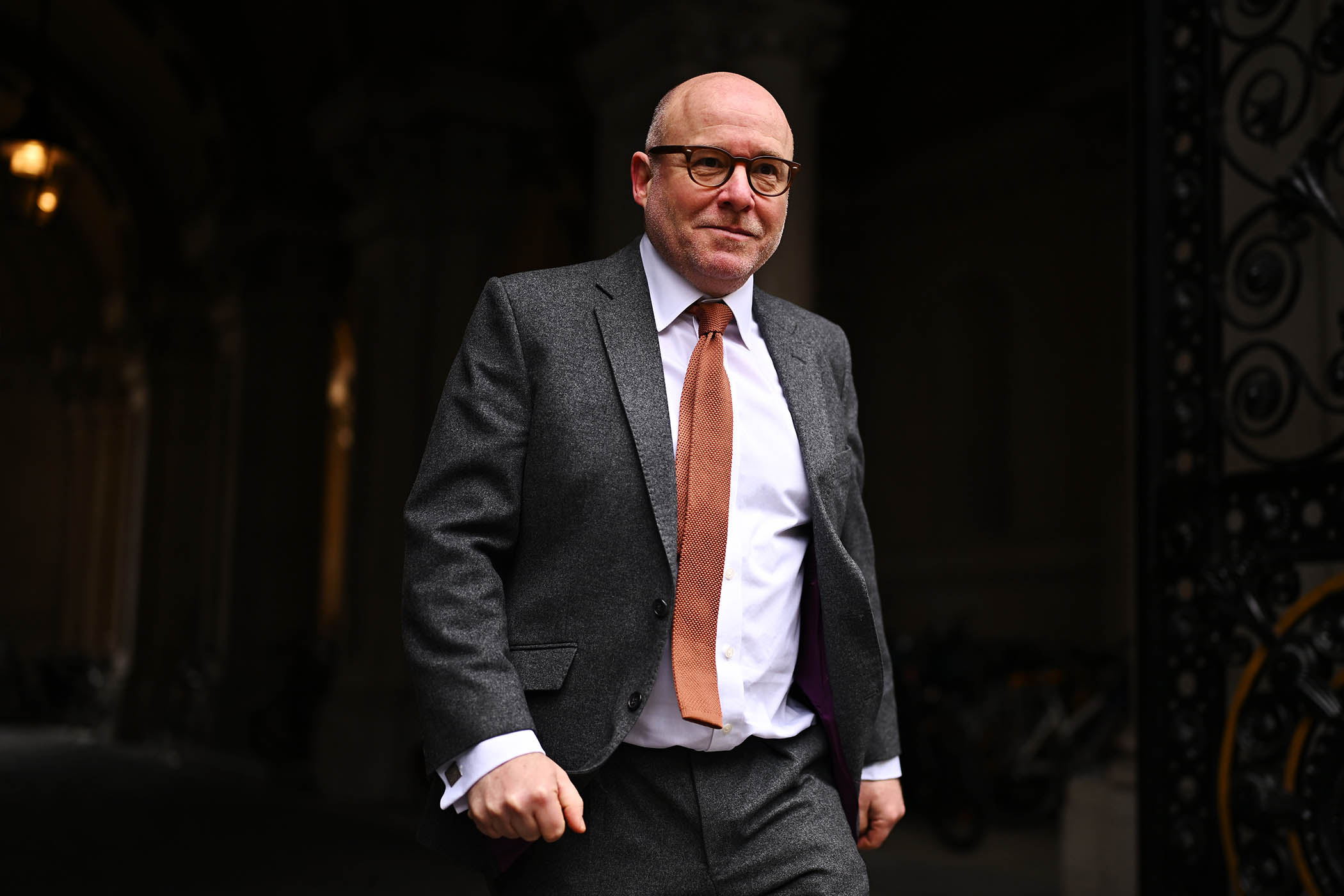 First government department quits X over racism and viole...observer.co.ukConcern about the spread of misinformation from right-wing figures prompts Richard Hermer to pull Attorney General’s Office off platform
In a stroke of genius, MS NOW decided to livestream the removal of Donald Trump's name from the Kennedy Center. As I write this, some three hours in, there are currently 48,630 viewers.
Into darkness and filth
"Blessed are the peacemakers! But woe to those who manipulate religion and the very name of God for their own military, economic and political gain, dragging that which is sacred into darkness and filth."
-- Pope Leo XIV, speaking in Cameroon on Thursday.
We would use different words
Colby Hall in Mediaite on how we've stopped being stunned by the batshit cabinet meetings hosted by President Trump, one of which was held on Thursday and lasted 98 minutes. Hall:
Here’s what I keep coming back to: if a transcript from this meeting came from the government of Brazil — or Hungary, or any country we cover from a comfortable critical distance — we would not file it as a cabinet meeting. We would write about it as a document. We would ask what it reveals about the man producing it and the institution that has formed around him. We would use different words.
But we don’t use different words for Trump. We stopped a long time ago, so gradually that I’m not sure anyone made a conscious decision to stop. It just became the way the job gets done.
And I say “we” deliberately, because Mediaite runs the clips too. We package the highlights. We write the posts. I’ve written more of them than I care to admit, and I’ll probably write more, as the traffic they generate is part of what keeps the lights on here. So I’m not throwing stones from outside the house. I live in this house. That’s actually why it bothers me.
America can't afford 'America First'
There is an enormous tension for an administration that now claims greatness as isolationism and regularly alienates and insults (and worse) global peers but also cannot finance itself without the support of other countries. These two opposing ideas operate at the center of the American debt story.
That is why “America First” does not make sense financially. The United States will no doubt, for the time being, find buyers of its debt — but the cost and terms of those exchanges are shifting as the rest of the world reconsiders its arrangements with President Trump’s way of doing business.
No society to defend
There are some things that have to be above politics. If there are not, then we have no society to defend.
-- Tory MP Geoffrey Cox in this remarkable speech to the House opposing the Labour Party's plan to abolish trial by jury for some cases, including for some serious offenses.
This from @Geoffrey_Cox was titanic - a truly beautiful speech.
— Joanna Hardy-Susskind (@Joanna__Hardy) March 10, 2026
He outshone those sat opposite. They could only watch. And nervously laugh.
This should be seen by every new MP to understand what they do, & every new barrister to understand what we do.pic.twitter.com/ePPZSFWGPA
The hated war
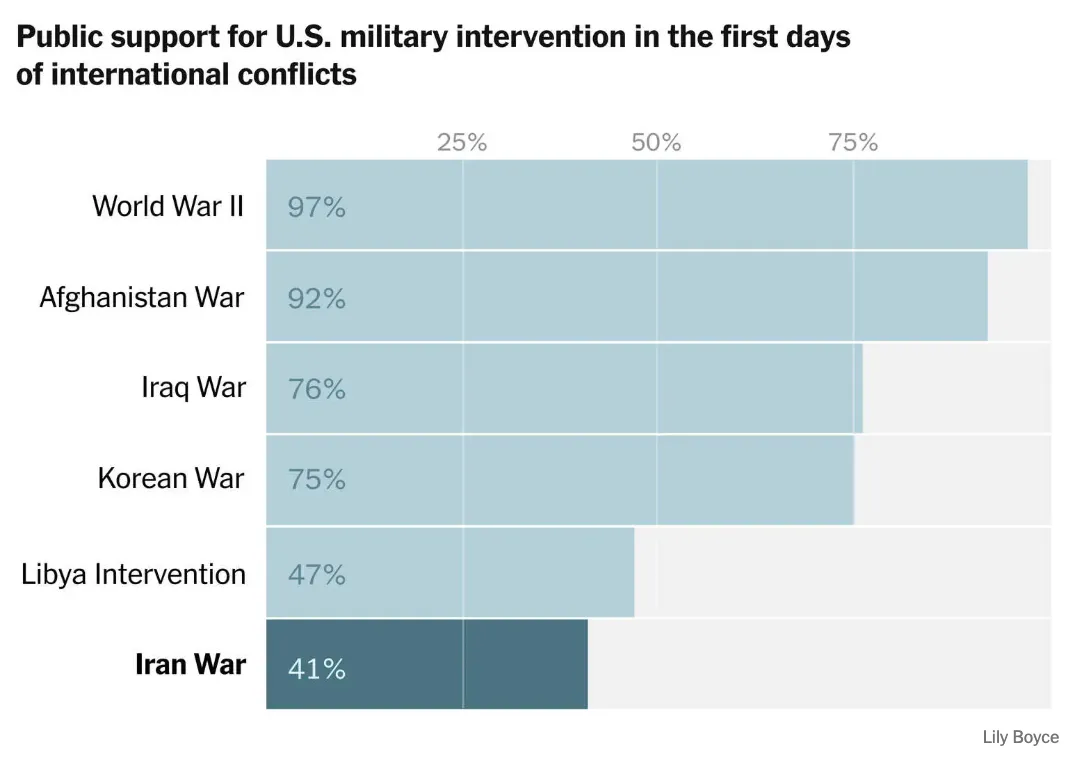
As well as there being no good reason for it, the newspaper reports, there has also been no effort to pretend there is one:
A part of this difference in support, said Sarah Maxey, an associate professor of international relations at Loyola University of Chicago, is the way previous presidents have taken the time to sell wars to the public.
“Before the Iraq War in 2003, we had a whole year of why this mattered, why we exhausted other operations, why we needed this,” said Ms. Maxey, who studies public opinion around war and foreign conflicts. “We have not had many foreign conflicts without a clear communication strategy beforehand.”
'Police journalism itself'
Historically, the First Amendment has limited the reach of consumer law to commercial speech or clear-cut fraud. By treating political bias as a defect in a commercial product, the F.T.C. is claiming the authority to police journalism itself.
-- the Editorial Board of the New York Times: Legally Creative, Democratically Dangerous: Trump’s Plan to Twist the News
Lacked credibility
Daniel Richman in the New York Times:
Calls for the Epstein files’ release predate the Trump administration. But they are now online and searchable because too many Americans didn’t trust the Justice Department’s leadership with control of them. In the past, departmental leaders could limit suspicions about their motives by conspicuously leaving a matter such as this to career subordinates, rather than political appointees. Seen by so many as having fired or driven out prosecutors and agents who refused to become tools of President Trump’s will, Attorney General Pam Bondi lacked credibility. She couldn’t get away with asking the public to rely on the apolitical and independent judgment of those who remained. The eventual result was the Epstein Files Transparency Act.
Read it all: The Epstein Files Should Never Have Been Released
Antifa in court
Brandy Zadrozny for MS NOW:
Prosecutors characterize the events that night as an “antifa attack” on the federal government. The defense calls it a protest gone wrong. But the implications of this trial extend beyond the fate of one group of activists: For the first time, federal prosecutors are seeking to convict protesters — most of them American citizens — on charges related to domestic terrorism. The outcome will test whether President Donald Trump’s yearslong campaign to brand leftist activists as terrorists can succeed in the courts.
Read it all: Trump wants to prosecute anti-fascists as terrorists. This Texas trial will test his power.
'Johnson is not a force'
Nia-Malika Henderson for Bloomberg Opinion on House Speaker Mike Johnson:
Although Johnson’s fundraising numbers are at a record high, with a haul of $82 million in 2025, Nancy Pelosi he is not. As speaker, Pelosi, who is retiring this year, let members vote their districts, even if it ran counter to her party’s position. She was a legislative tactician, helping muscle through landmark legislation in the Barack Obama and Joe Biden administrations, even with a small majority. And more than that, her charismatic personality, the memes and the quips, helped brand the party as a force.
Johnson is not a force. More follower than leader, he has spent much of this year standing back, watching as his power and the power of his chamber are eroded.
It’s no wonder so many Republicans want out.