Dave Lee

Everything tagged #byothers

A clear violation

A note attached to a New York Times book review:

Editors’ Note: March 30, 2026:

A reader recently alerted The Times that this review included language and details similar to those in a review of the same book published in The Guardian. We spoke to the author of this piece, a freelancer reviewer, who told us he used an A.I. tool that incorporated material from the Guardian review into his draft, which he failed to identify and remove. His reliance on A.I. and his use of unattributed work by another writer are a clear violation of The Times’s standards. The reviewer said he had not used A.I. in his previous reviews for The Times, and we have found no issues in those pieces. The Guardian review of “Watching Over Her” can be read here.

You can't defeat the robots

Minnesota Twins manager Derek Shelton becomes to the first to be ejected from the game for becoming infuriated at the decision of the robot umpire.

This season, which started this weekend, is the first to include the controversial technology.

The commentator's call is pretty special:

We would use different words

Colby Hall in Mediaite on how we've stopped being stunned by the batshit cabinet meetings hosted by President Trump, one of which was held on Thursday and lasted 98 minutes. Hall:

Here’s what I keep coming back to: if a transcript from this meeting came from the government of Brazil — or Hungary, or any country we cover from a comfortable critical distance — we would not file it as a cabinet meeting. We would write about it as a document. We would ask what it reveals about the man producing it and the institution that has formed around him. We would use different words.

But we don’t use different words for Trump. We stopped a long time ago, so gradually that I’m not sure anyone made a conscious decision to stop. It just became the way the job gets done.

And I say “we” deliberately, because Mediaite runs the clips too. We package the highlights. We write the posts. I’ve written more of them than I care to admit, and I’ll probably write more, as the traffic they generate is part of what keeps the lights on here. So I’m not throwing stones from outside the house. I live in this house. That’s actually why it bothers me.

Greenland sharks

Katherine Rundell:

In​ 1606 a devastating pestilence swept through London; the dying were boarded up in their homes with their families, and a decree went out that the theatres, the bear-baiting yards and the brothels be closed. It was then that Shakespeare wrote one of his very few references to the plague, catching at our precarity: ‘The dead man’s knell/Is there scarce asked for who, and good men’s lives/Expire before the flowers in their caps/Dying or ere they sicken.’ As he wrote, a Greenland shark who is still alive today swam untroubled through the waters of the northern seas. Its parents would have been old enough to have lived alongside Dante; its great-great-grandparents alongside Julius Caesar. For thousands of years Greenland sharks have swum in silence, as above them the world has burned, rebuilt, burned again.

Amputee murderer couldn't dispose of the body

What's the opposite of burying the lede?

NPR:

A professional cornhole player who is a quadruple amputee has been arrested in connection with a fatal shooting.

Blimey. Being a quadruple amputee apparently not enough of a hindrance to shoot a man, but hiding the body was an altogether trickier matter:

The sheriff's office said in a press release that passengers in the backseat saw Webber shoot Bradrick Michael Wells, also 27, before he pulled over and asked them "to help pull the victim out of the car." They refused and left, at which point Webber "fled with the victim still in the car." All of the passengers knew each other, authorities said.

Nearly two hours later, a resident of Charlotte Hall, Md., about 14 miles away, called police to report "a body in a yard," the sheriff's office said.

Beauties of my style

Smithsonian Magazine on a new exhibition at Yale University celebrating five centuries of typos. Begins with an anecdote about James Joyce's Ulysses, first editions of which were full of typos on account of the Irishman's bad handwriting:

The following year, Joyce’s editors compiled a massive list of the book’s errors to be fixed in new editions. Joyce rejected some of the corrections, saying, “These are not misprints but beauties of my style hitherto undreamt of.” Even so, some future printings of the book came with a seven-page errata sheet listing more than 200 mistakes.

Planning to steal "These are not misprints but beauties of my style hitherto undreamt of" the next time I have to correct an article.

The middle

A terrific essay on something that seems irretrievably lost. Rodrigo Brancatelli in his newsletter, Found Object:

This is not an essay about movies, tho. Have you noticed that the middle is gone from everything? Restaurants, companies, careers, music, retail, the economy itself. What replaced it is a barbell: one enormous weight on each end, nothing in the center, and most of us trying not to get crushed by the bar.

And the replacement does look better every single time, I grant you that. The A24 film is better than the $40 million adult drama from 2007, yeah, we can all agree on that. The Sweetgreen bowl is better than the Applebee’s chicken parm, sure. Your favorite Substack is sharper than the mid-list magazine that folded in 2019. Every replacement is a genuine upgrade. But every replacement serves fewer and fewer people. And nobody seems to think that’s a problem, which is how you know who the replacements were built for.

A war reporter in the middle of a betting war

A Times of Israel reporter has been receiving death threats over his refusal to "correct" an article about a missile strike on a city near Jerusalem. The reason? His reporting was the final word that determined a market on Polymarket.

Emanuel Fabian writes:

My minor report on a missile striking an open area was now in the middle of a betting war, with those who had bet “No” on an Iranian strike on Israel on March 10 demanding I change my article to ensure they would win big.

Of course, Fabian refused to amend the article. So, over the course of a weekend, the threats intensified. A person identifying themselves only as "Haim" began texting him in Hebrew over WhatsApp, Fabian wrote:

Later in the afternoon, Haim messaged me again, this time with the most explicit threat yet.

“You have 90 minutes left to update the lie. If you do this — you solve in a minute the most serious problem you have caused yourself in life. And you won’t remember me anymore in a week.”

“If you decide not to correct it, and leave the lie intact, you will discover enemies who will be willing to pay anything to make your life miserable — within the framework of the law.”

“And as far as I know, there are also some people who don’t really care about the law, and you’re going to make them lose about 50 times what you’ll ever make.”

“86 minutes left. You are the only one responsible for your life.”

Thankfully, the threats were hollow. And Fabian, evidently, is a man of solid ethics. But he raises the point: What might less-ethical journalists, or more afraid, journalists do in his situation? "I do worry that other journalists may not be as ethical if they are promised some of the winnings," he wrote.
America can't afford 'America First'

Kyla Scanlon:

There is an enormous tension for an administration that now claims greatness as isolationism and regularly alienates and insults (and worse) global peers but also cannot finance itself without the support of other countries. These two opposing ideas operate at the center of the American debt story.

That is why “America First” does not make sense financially. The United States will no doubt, for the time being, find buyers of its debt — but the cost and terms of those exchanges are shifting as the rest of the world reconsiders its arrangements with President Trump’s way of doing business.

No society to defend

There are some things that have to be above politics. If there are not, then we have no society to defend.

-- Tory MP Geoffrey Cox in this remarkable speech to the House opposing the Labour Party's plan to abolish trial by jury for some cases, including for some serious offenses.

Amazon's AI 'high blast radius'

Rafe Rosner-Uddin for the Financial Times:

Amazon’s ecommerce business has summoned a large group of engineers to a meeting on Tuesday for a “deep dive” into a spate of outages, including incidents tied to the use of AI coding tools.

The online retail giant said there had been a “trend of incidents” in recent months, characterised by a “high blast radius” and “Gen-AI assisted changes” among other factors, according to a briefing note for the meeting seen by the FT.

Under “contributing factors” the note included “novel GenAI usage for which best practices and safeguards are not yet fully established”.

Oh dear! From now on, the company said, all code changes from junior and mid-level engineers that involved AI generation must be signed off by a superior. Which you'd think would have been the case anyway.

Curiously, after the FT's report, according to CNBC, the reference to AI was removed from the memo:

Earlier on Tuesday, an internal document indicated that “GenAI-assisted changes” involving “GenAI tools” were a factor in a “trend of incidents” since the third quarter. However, the bullet point referencing GenAI was deleted before the meeting, according to an updated version of the document viewed by CNBC and a person familiar with the matter who asked not to be named because of confidentiality.

After initial publication of this story, an Amazon spokesperson said a single incident was related to AI and none of the incidents involved AI-written code.

Deleted from the memo, but not deleted from the discussion itself, I'd wager.

The hated war

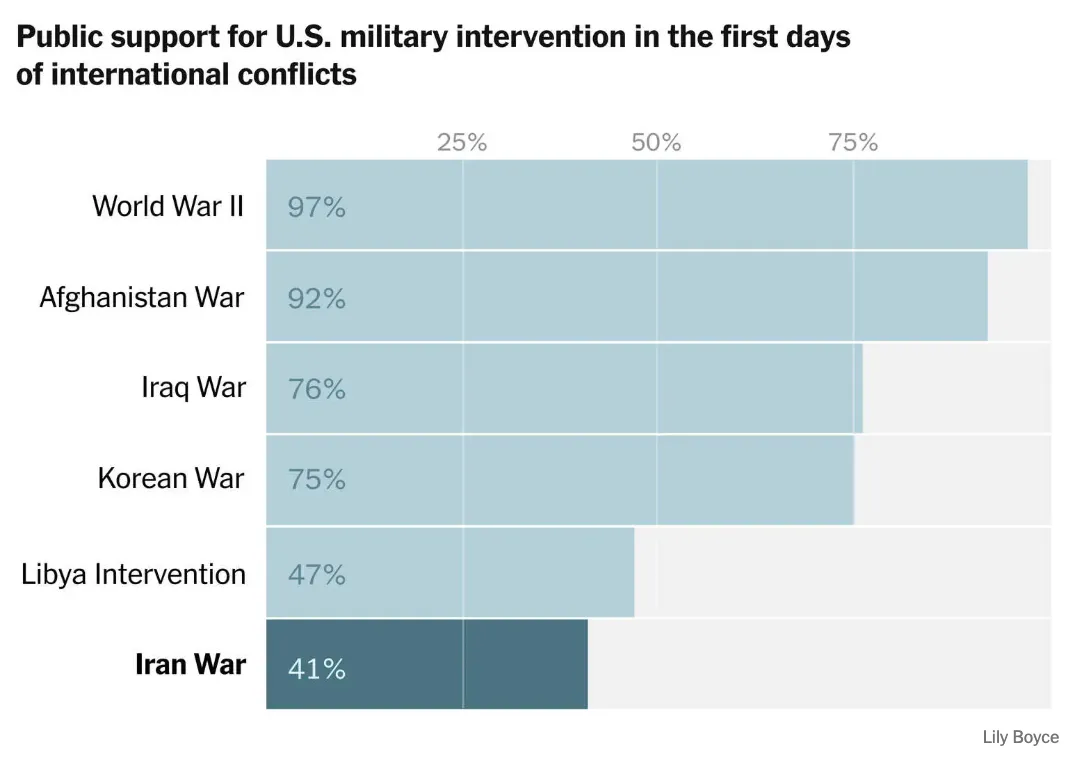
From the New York Times:

Screenshot 2026-03-10 at 11

As well as there being no good reason for it, the newspaper reports, there has also been no effort to pretend there is one:

A part of this difference in support, said Sarah Maxey, an associate professor of international relations at Loyola University of Chicago, is the way previous presidents have taken the time to sell wars to the public.

“Before the Iraq War in 2003, we had a whole year of why this mattered, why we exhausted other operations, why we needed this,” said Ms. Maxey, who studies public opinion around war and foreign conflicts. “We have not had many foreign conflicts without a clear communication strategy beforehand.”

He pays for the shoes

image (Reuters)

The Wall Street Journal reports:

Trump has fallen in love with Florsheim, the American brand that’s been pairing comfort and style for more than a century. They’re also affordable: many cost $145.

The president has taken to guessing people’s shoe size in front of them. He asks an aide to put in an order and, a week later, a brown Florsheim box arrives at the White House. Trump sometimes signs the box or attaches a note of gratitude, according to people familiar with the ritual.

The 79-year-old billionaire, known for expensive Brioni suits, long red ties and a penchant for aesthetics, late last year began searching for something that would feel better after a day on the job and settled on Florsheim. Trump liked them so much he started dispensing them. He pays for the shoes, the White House said.

The thing is... he's absolutely right. They are very comfortable shoes.

Closed labyrinth

A great essay from iA, the firm behind the excellent minimalist writing app Writer, discussing what it would take for Europe to decouple itself from US-made technology. Specifically, Microsoft Office:

Microsoft Office traps us in a world that vanished decades ago. Like the workplace in Severance, it holds us in a closed labyrinth where, instead of thinking, we click. Europe says it wants out. But how exactly do we escape the maze? And where would we go?

Of course, iA has a vested interest: Their solution to the issue looks a lot like the products they sell. But the argument is solid. The essay continues:

If Europe wants to prepare for digital conflicts, it should not just swap vendors. It should leave obsolete work models behind. The smartest way to strengthen digital independence is not replacing bad software with wobbly clones. It is making work meaningful and enjoyable. Europe does not need a European Microsoft. Europe, and not just Europe, needs a post-Office model of writing, calculating, and presenting.

The best way to weaken a dependency is to stop relying on outdated systems in the first place. Good technology moves from raw to complex to simple. It’s time to move from the complex Office to a simpler solution. So, how about plain text? Imagine writing and presentation software where all you do is think about what you want to say. The app makes sure that it looks on brand. Yes. That is not just possible. It exists already. But adapting it will require a change of habit, not just a change of vendor.

Can a horse frown?

Step away from the news agenda and dive into this fascinating post from Brian Klaas:

In the early 1800s, the Scottish anatomist Charles Bell argued that facial expressions were uniquely human. The smile, the frown, the grimace were each forged by God, bestowed on us through a complex array of tiny invisible muscles giving us unrivalled capabilities at emotional, moral, and spiritual expression. Through our faces, Bell argued, humans bared their souls for all to see—something a lesser animal without our divine spark could never hope to achieve.

His logical proof was simple: if God had wanted non-human animals to reveal their inner souls, he would have given them facial muscles like ours.

Bell’s argument had a small flaw: he was completely wrong.

What follows is a dense, but immensely readable, exploration of the wealth of data that our faces give up.