
Dave Lee
My WorkBlog· updated 19 hours ago

Interesting links, noteworthy journalism and other miscellanea from around the web.

AI Derangement Syndrome

In his Labor Notes newsletter, Gad Levanon discusses AI Derangement Syndrome:

I didn’t make up this term. I’m describing it as a condition in which otherwise intelligent people lose the ability to think clearly about artificial intelligence and its impact on the economy and labor market. The symptoms are persistent, largely immune to data, and tend to worsen with each new model release. After two years of tracking AI related discussions, I’ve classified the syndrome into five common variants.

I'm big enough to admit I've been afflicted by several of the five variants at one time or another. Read the post to learn what they are, and then take Levanon's advice:

The treatment is simple: Pay for a frontier model. Use it seriously for a month. Apply it to your actual work. Try research. Try drafting. Try analysis. Try the tools, not just the chat.

Lacked credibility

Daniel Richman in the New York Times:

Calls for the Epstein files’ release predate the Trump administration. But they are now online and searchable because too many Americans didn’t trust the Justice Department’s leadership with control of them. In the past, departmental leaders could limit suspicions about their motives by conspicuously leaving a matter such as this to career subordinates, rather than political appointees. Seen by so many as having fired or driven out prosecutors and agents who refused to become tools of President Trump’s will, Attorney General Pam Bondi lacked credibility. She couldn’t get away with asking the public to rely on the apolitical and independent judgment of those who remained. The eventual result was the Epstein Files Transparency Act.

Read it all: The Epstein Files Should Never Have Been Released

Dogmatic belief

Gina Chua, executive director of the Tow-Knight Center (and executive editor of Semafor), with a sweepy post on the journalism industry's contorted view of AI's potential. She makes a lot of great points but my takeaway was this:

If the starting point of the debate is what-can-humans-do-better-than-machines, rather than what-does-the-public-we-serve-need, then we’ll end up prioritizing ensuring we have jobs, rather than ensuring we serve communities well.

That’s also an overstatement, of course; and I’ve written many times about the multiple roles I believe humans need to play in the coming information landscape.

But the fundamental issue is a dogmatic belief that machines can’t surpass us, in the face of a body of evidence that they already do in a range of processes.

A true homily

The pope tells priests not to use AI to write homilies, reports the National Catholic Reporter:

"Like all the muscles in the body, if we do not use them, if we do not move them, they die. The brain needs to be used, so our intelligence must also be exercised a little so as not to lose this capacity," Leo said in the closed door meeting, according to a report by Vatican News on Feb. 20.

"To give a true homily is to share faith," and artificial intelligence "will never be able to share faith," the pope added.

Amazon's 'hollow victory'

Screenshot 2026-02-19 at 2

Bloomberg's Spencer Soper:

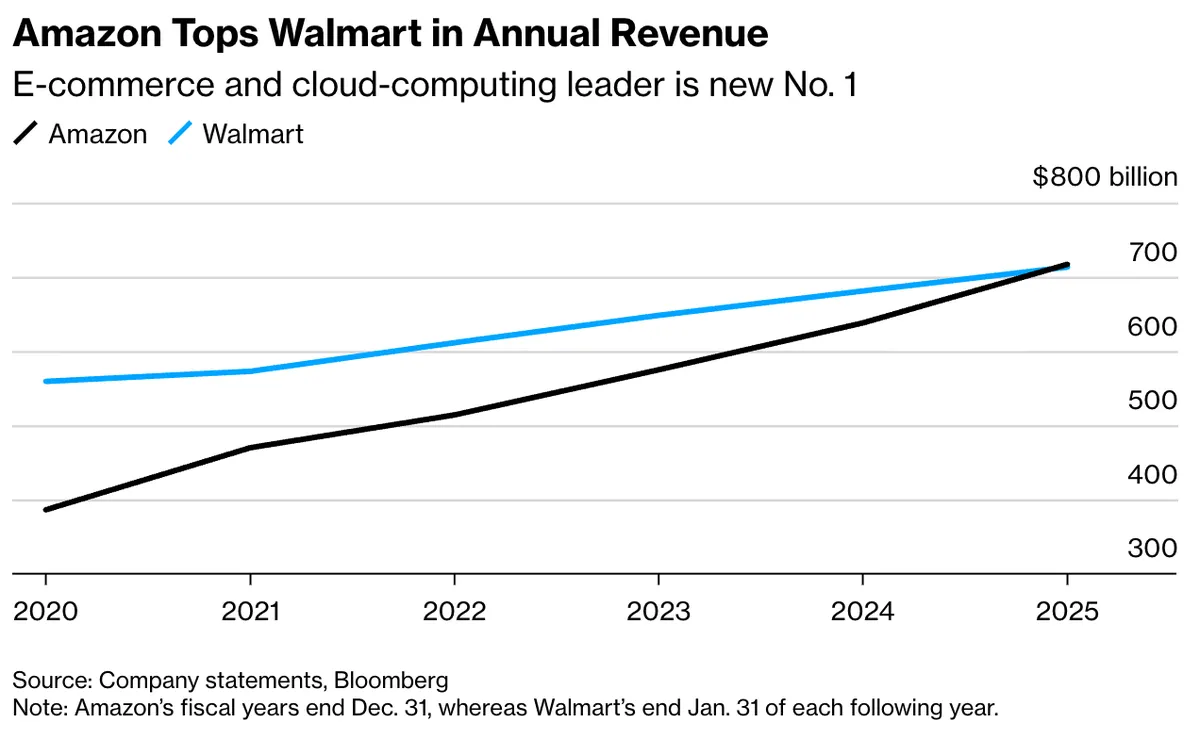
Amazon.com Inc. has officially dethroned Walmart Inc. as the biggest global company by revenue, a milestone attesting to the massive scale the e-commerce and cloud-computing giant has achieved since its humble beginnings in 1994 as an online bookseller in Jeff Bezos’ Seattle-area garage.

Walmart, which had been the largest company by revenue for more than a decade, on Thursday reported sales of $713.2 billion for the 12 months ending Jan. 31. Amazon, which operates on a fiscal year ending in December, earlier this month reported 2025 sales of $717 billion.

I get the sense that if you were to stop 50 people in the street almost all of them would have assumed that Amazon had passed this milestone long ago. Especially since, as Spencer's article notes, Amazon has for a long time done so much more:

But the revenue story is more about Amazon’s dominance in cloud computing, a business Walmart doesn’t compete in. Without AWS, Amazon’s 2025 revenue would have been $588 billion. So its ascendance rests largely on the importance of data centers as critical infrastructure in the age of artificial intelligence.

“This is a hollow victory,” said Kirthi Kalyanam, executive director of the Retail Management Institute at Santa Clara University. “Amazon didn’t beat Walmart in the retail game. It just beat them in revenue by launching a new business Walmart doesn’t operate in.”

So in some ways the story is less about how big Amazon is, and more about how Walmart is still such a juggernaut.

Fieri

How do you teach a white man not to be a Nazi? How do you teach him not to hate in a world filled with it? How do you teach a boy not to hate women when so many of his peers already do? How do you steer him away from everything that the algorithm is pushing him toward?

-- Author and journalist Lyz Lenz on how Guy Fieri, of all people, helped her son connect with food and, in doing so, his mother too.

Read it all: What Guy Fieri taught my son

Billionaires gone wild

IMG_5689

Paul Krugman’s newsletter this morning:

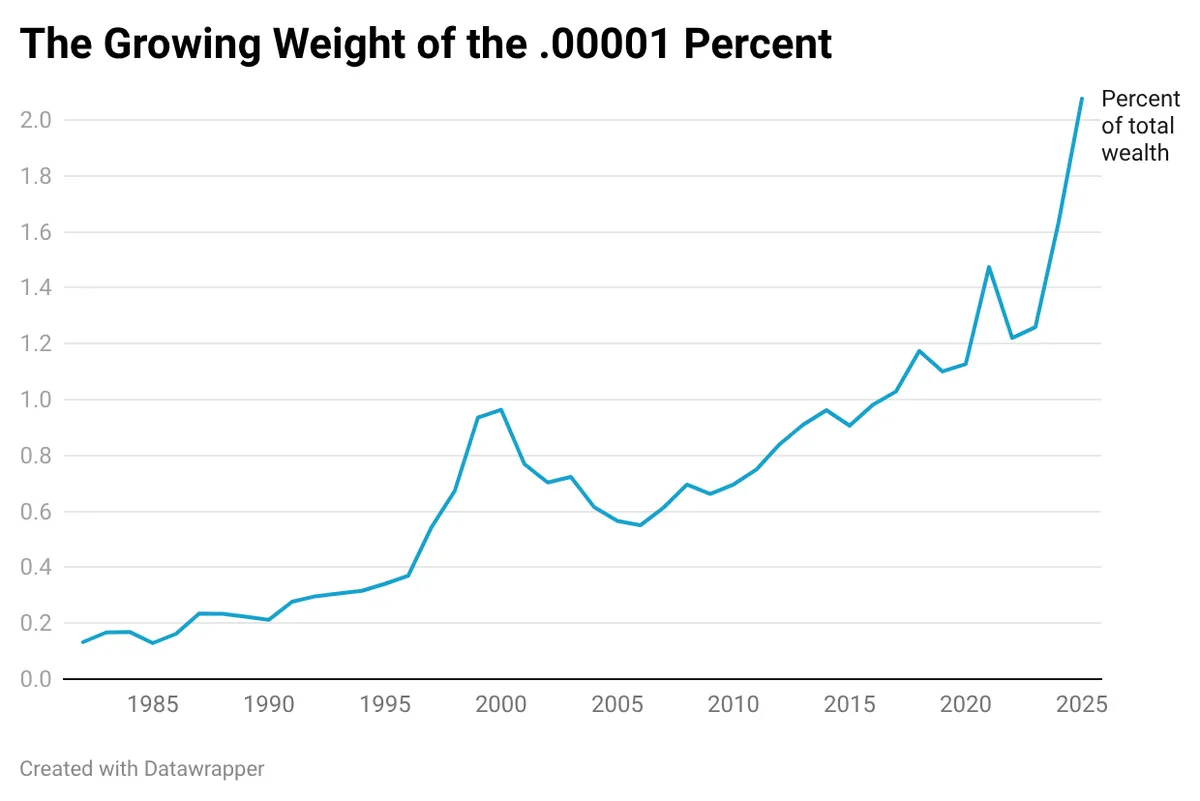
Wealth in America is now more concentrated in a few hands than it was during the Gilded Age of the late 19th and early 20th century. Money has always been a potent source of political influence, so this vast increase in concentrated wealth at the top inevitably translates into increased power.

However, after Citizens United America experienced an increase in oligarchic power far surpassing even what one might have expected given soaring wealth at the top. At this point it’s clear that we have experienced a fundamental change in the way our society works. Everything that is downstream of the American political system – federal and state governments, the courts, regulatory power, economic policy, health policy, media independence – and of course democracy itself – is under extreme threat from the tidal wave of billionaire influence.

'JPEG of thought'

In The Register, a very interesting breakdown of what's going on when generative AI edits decent writing and churns out an "improvement" that is so horridly dull:

Stage 1: Metaphoric cleansing. The AI identifies unconventional metaphors or visceral imagery as "noise" because they deviate from the training set's mean. It replaces them with dead, safe clichés, stripping the text of its emotional and sensory "friction."

Stage 2: Lexical flattening. Domain-specific jargon and high-precision technical terms are sacrificed for "accessibility." The model performs a statistical substitution, replacing a 1-of-10,000 token with a 1-of-100 synonym, effectively diluting the semantic density and specific gravity of the argument.

Stage 3: Structural collapse. The logical flow – originally built on complex, non-linear reasoning – is forced into a predictable, low-perplexity template. Subtext and nuance are ablated to ensure the output satisfies a "standardized" readability score, leaving behind a syntactically perfect but intellectually void shell.

The result, suggests Claudio Nastruzzi, is a "JPEG of thought" -- meaning an end product that is "visually coherent but stripped of its original data density through semantic ablation."

Antifa in court

Brandy Zadrozny for MS NOW:

Prosecutors characterize the events that night as an “antifa attack” on the federal government. The defense calls it a protest gone wrong. But the implications of this trial extend beyond the fate of one group of activists: For the first time, federal prosecutors are seeking to convict protesters — most of them American citizens — on charges related to domestic terrorism. The outcome will test whether President Donald Trump’s yearslong campaign to brand leftist activists as terrorists can succeed in the courts.

Read it all: Trump wants to prosecute anti-fascists as terrorists. This Texas trial will test his power.

The Broomway

Screenshot 2026-02-16 at 4

An Amazon driver makes an ancient mistake off the coast of south east England. CNN:

An Amazon delivery van had to be recovered after its driver followed a GPS route onto “extremely dangerous” mudflats.

English coastguards received a call on Sunday morning about the incident the previous evening, according to a Facebook post by HM Coastguard Southend.

They said the van had driven onto The Broomway, a six-mile path dating back 600 years that is not intended for vehicles.

The driver had been “following a GPS route” trying to reach Foulness Island, off the east coast of the county of Essex, according to the coastguard Facebook post.

Let's just say the driver, who got back to shore safely, was not the first to be bested by the hazardous track. The Broomway's origins are not clear -- it may have even been used by the Romans, in some form -- but it's death toll is notorious. For some time it was known as the road that took more lives than Mount Everest, though that's either outdated or was never actually true. More than 300 people are known to have perished on Everest; the Broomway has recorded about 100 deaths.

The road joins mainland Britain to Foulness Island, now home to a military base. How did the road get its name? From the Southend Echo, in 2006:

Local people knew these rules and respected them, but even they risked a third, wild-card danger. This was the sea-mist, which could, seemingly from nowhere, suddenly swirl across the path, blanking out all vision.

To guide travellers, local people resorted to a unique device. On either side of the Broomway, at 30 yard intervals, they drove stakes. To these stakes they tied bundles of twigs, giving the appearance of a witch's broom, or besom.

Unfortunately for the van driver, the brooms are long gone, washed away with history. Visitors to the island are advised to use the more modern route just north of where the driver lost his way. Amazon is said to have arranged a local farmer to help retrieve the vehicle.
'Johnson is not a force'

Nia-Malika Henderson for Bloomberg Opinion on House Speaker Mike Johnson:

Although Johnson’s fundraising numbers are at a record high, with a haul of $82 million in 2025, Nancy Pelosi he is not. As speaker, Pelosi, who is retiring this year, let members vote their districts, even if it ran counter to her party’s position. She was a legislative tactician, helping muscle through landmark legislation in the Barack Obama and Joe Biden administrations, even with a small majority. And more than that, her charismatic personality, the memes and the quips, helped brand the party as a force.

Johnson is not a force. More follower than leader, he has spent much of this year standing back, watching as his power and the power of his chamber are eroded.

It’s no wonder so many Republicans want out.

Blood in the machine

How's this for an irresistible lede? From gaming news site Aftermath:

Back in 2023, a (slightly) more innocent time before Microsoft ravaged its games studios with layoffs and made itself into a BDS priority target, Blizzard held a competition: To promote Diablo IV’s second season, it raffled off a PC "infused with real human blood in its liquid cooling" as part of a blood drive seeking 666 quarts of the red goop that keeps us all alive. I was desperate to know more. How much blood? Whose blood? Can blood reliably and sustainably cool a PC? And, again, whose blood?

Read it all: Diablo IV PC Cooled With Real Human Blood Is Still Going Strong Two Years Later, Says Guy Who Won It

(Also check out Brian Merchant's excellent book on the Luddites, from which I stole the title for this post.)

AI job creation

An absolutely crackers story from 404 Media:

Waymo, Google’s autonomous vehicle company, and DoorDash, the delivery and gig work platform, have launched a pilot program that pays Dashers, at least in one case, around $10 to travel to a parked Waymo and close its door that the previous passenger left open, according to a joint statement from the company given to 404 Media.

Remarkable. Read it all: Waymo Is Getting DoorDashers to Close Doors on Self Driving Cars ($)