Dave Lee
My WorkBlog· updated 17 hours ago

Interesting links, noteworthy journalism and other miscellanea from around the web.

The middle

A terrific essay on something that seems irretrievably lost. Rodrigo Brancatelli in his newsletter, Found Object:

This is not an essay about movies, tho. Have you noticed that the middle is gone from everything? Restaurants, companies, careers, music, retail, the economy itself. What replaced it is a barbell: one enormous weight on each end, nothing in the center, and most of us trying not to get crushed by the bar.

And the replacement does look better every single time, I grant you that. The A24 film is better than the $40 million adult drama from 2007, yeah, we can all agree on that. The Sweetgreen bowl is better than the Applebee’s chicken parm, sure. Your favorite Substack is sharper than the mid-list magazine that folded in 2019. Every replacement is a genuine upgrade. But every replacement serves fewer and fewer people. And nobody seems to think that’s a problem, which is how you know who the replacements were built for.
A war reporter in the middle of a betting war

A Times of Israel reporter has been receiving death threats over his refusal to "correct" an article about a missile strike on a city near Jerusalem. The reason? His reporting was the final word that determined a market on Polymarket.

Emanuel Fabian writes:

My minor report on a missile striking an open area was now in the middle of a betting war, with those who had bet “No” on an Iranian strike on Israel on March 10 demanding I change my article to ensure they would win big.

Of course, Fabian refused to amend the article. So, over the course of a weekend, the threats intensified. A person identifying themselves only as "Haim" began texting him in Hebrew over WhatsApp, Fabian wrote:

Later in the afternoon, Haim messaged me again, this time with the most explicit threat yet.

“You have 90 minutes left to update the lie. If you do this — you solve in a minute the most serious problem you have caused yourself in life. And you won’t remember me anymore in a week.”

“If you decide not to correct it, and leave the lie intact, you will discover enemies who will be willing to pay anything to make your life miserable — within the framework of the law.”

“And as far as I know, there are also some people who don’t really care about the law, and you’re going to make them lose about 50 times what you’ll ever make.”

“86 minutes left. You are the only one responsible for your life.”

Thankfully, the threats were hollow. And Fabian, evidently, is a man of solid ethics. But he raises the point: What might less-ethical journalists, or more afraid, journalists do in his situation? "I do worry that other journalists may not be as ethical if they are promised some of the winnings," he wrote.

America can't afford 'America First'

Kyla Scanlon:

There is an enormous tension for an administration that now claims greatness as isolationism and regularly alienates and insults (and worse) global peers but also cannot finance itself without the support of other countries. These two opposing ideas operate at the center of the American debt story.

That is why “America First” does not make sense financially. The United States will no doubt, for the time being, find buyers of its debt — but the cost and terms of those exchanges are shifting as the rest of the world reconsiders its arrangements with President Trump’s way of doing business.

No society to defend

There are some things that have to be above politics. If there are not, then we have no society to defend.

-- Tory MP Geoffrey Cox in this remarkable speech to the House opposing the Labour Party's plan to abolish trial by jury for some cases, including for some serious offenses.

Amazon's AI 'high blast radius'

Rafe Rosner-Uddin for the Financial Times:

Amazon’s ecommerce business has summoned a large group of engineers to a meeting on Tuesday for a “deep dive” into a spate of outages, including incidents tied to the use of AI coding tools.

The online retail giant said there had been a “trend of incidents” in recent months, characterised by a “high blast radius” and “Gen-AI assisted changes” among other factors, according to a briefing note for the meeting seen by the FT.

Under “contributing factors” the note included “novel GenAI usage for which best practices and safeguards are not yet fully established”.

Oh dear! From now on, the company said, all code changes from junior and mid-level engineers that involved AI generation must be signed off by a superior. Which you'd think would have been the case anyway.

Curiously, after the FT's report, according to CNBC, the reference to AI was removed from the memo:

Earlier on Tuesday, an internal document indicated that “GenAI-assisted changes” involving “GenAI tools” were a factor in a “trend of incidents” since the third quarter. However, the bullet point referencing GenAI was deleted before the meeting, according to an updated version of the document viewed by CNBC and a person familiar with the matter who asked not to be named because of confidentiality.

After initial publication of this story, an Amazon spokesperson said a single incident was related to AI and none of the incidents involved AI-written code.

Deleted from the memo, but not deleted from the discussion itself, I'd wager.

The hated war

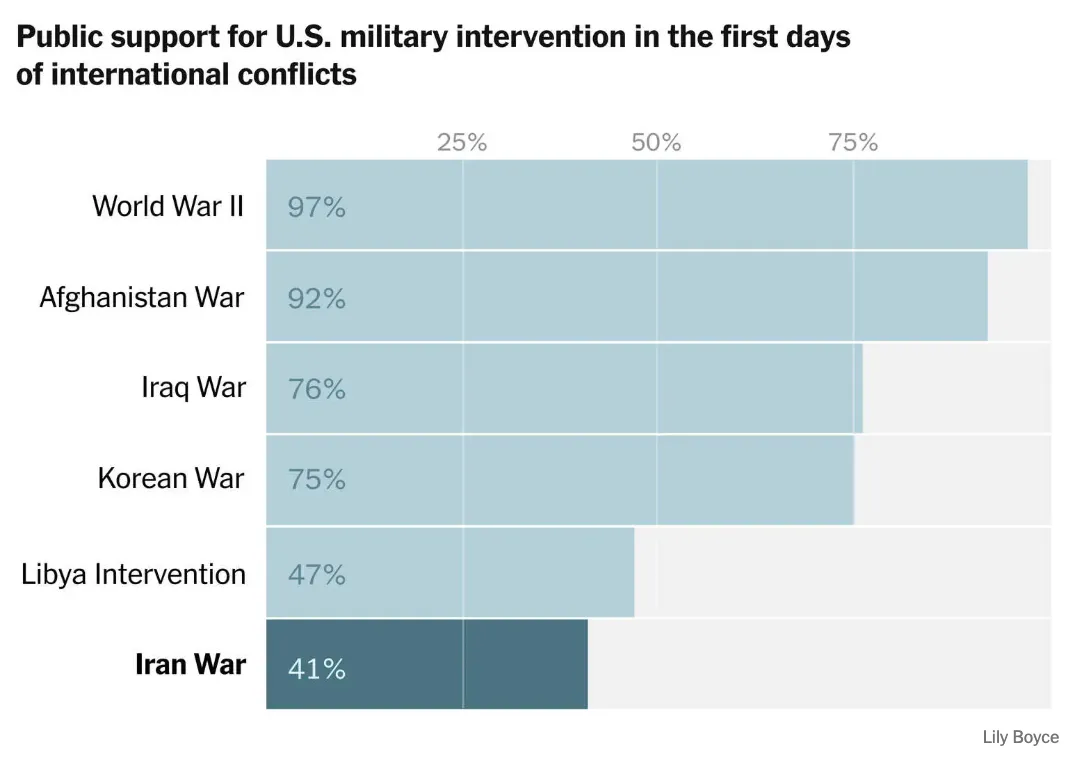
From the New York Times:

Screenshot 2026-03-10 at 11

As well as there being no good reason for it, the newspaper reports, there has also been no effort to pretend there is one:

A part of this difference in support, said Sarah Maxey, an associate professor of international relations at Loyola University of Chicago, is the way previous presidents have taken the time to sell wars to the public.

“Before the Iraq War in 2003, we had a whole year of why this mattered, why we exhausted other operations, why we needed this,” said Ms. Maxey, who studies public opinion around war and foreign conflicts. “We have not had many foreign conflicts without a clear communication strategy beforehand.”

He pays for the shoes

image (Reuters)

The Wall Street Journal reports:

Trump has fallen in love with Florsheim, the American brand that’s been pairing comfort and style for more than a century. They’re also affordable: many cost $145.

The president has taken to guessing people’s shoe size in front of them. He asks an aide to put in an order and, a week later, a brown Florsheim box arrives at the White House. Trump sometimes signs the box or attaches a note of gratitude, according to people familiar with the ritual.

The 79-year-old billionaire, known for expensive Brioni suits, long red ties and a penchant for aesthetics, late last year began searching for something that would feel better after a day on the job and settled on Florsheim. Trump liked them so much he started dispensing them. He pays for the shoes, the White House said.

The thing is... he's absolutely right. They are very comfortable shoes.

Closed labyrinth

A great essay from iA, the firm behind the excellent minimalist writing app Writer, discussing what it would take for Europe to decouple itself from US-made technology. Specifically, Microsoft Office:

Microsoft Office traps us in a world that vanished decades ago. Like the workplace in Severance, it holds us in a closed labyrinth where, instead of thinking, we click. Europe says it wants out. But how exactly do we escape the maze? And where would we go?

Of course, iA has a vested interest: Their solution to the issue looks a lot like the products they sell. But the argument is solid. The essay continues:

If Europe wants to prepare for digital conflicts, it should not just swap vendors. It should leave obsolete work models behind. The smartest way to strengthen digital independence is not replacing bad software with wobbly clones. It is making work meaningful and enjoyable. Europe does not need a European Microsoft. Europe, and not just Europe, needs a post-Office model of writing, calculating, and presenting.

The best way to weaken a dependency is to stop relying on outdated systems in the first place. Good technology moves from raw to complex to simple. It’s time to move from the complex Office to a simpler solution. So, how about plain text? Imagine writing and presentation software where all you do is think about what you want to say. The app makes sure that it looks on brand. Yes. That is not just possible. It exists already. But adapting it will require a change of habit, not just a change of vendor.

Can a horse frown?

Step away from the news agenda and dive into this fascinating post from Brian Klaas:

In the early 1800s, the Scottish anatomist Charles Bell argued that facial expressions were uniquely human. The smile, the frown, the grimace were each forged by God, bestowed on us through a complex array of tiny invisible muscles giving us unrivalled capabilities at emotional, moral, and spiritual expression. Through our faces, Bell argued, humans bared their souls for all to see—something a lesser animal without our divine spark could never hope to achieve.

His logical proof was simple: if God had wanted non-human animals to reveal their inner souls, he would have given them facial muscles like ours.

Bell’s argument had a small flaw: he was completely wrong.

What follows is a dense, but immensely readable, exploration of the wealth of data that our faces give up.

Overcompensating hardass uncle

Rusty Foster in Today In Tabs:

We kicked off this war of long-distance pre-taliatory liberation by precision bombing a girls’ school and killing 165 people—“most of them girls aged between 7 and 12”—allegedly to free them from the oppressive yoke of a regime that, I’m told, won’t let girls go to school. I guess they’re free now. “All I can say is we’re investigating that,” said Defense Secretary and overcompensating hardass uncle Pete Hegseth, who clearly couldn’t care less. But when an Iranian drone managed to slip through our $5 billion dollar a day missile shield and kill six Americans in Kuwait, Hegseth could barely pretend to care about that either. “Tragic things happen,” he said. “The press only wants to make the president look bad.” He doesn’t give a shit.

The Gemini chatbot he called his wife

Julie Jargon in the Wall Street Journal:

Jonathan Gavalas embarked on several real-world missions to secure a body for the Gemini chatbot he called his wife, according to a lawsuit his father brought against the chatbot’s maker, Alphabet’s Google.

When the delusion-fueled plan crumbled, Gemini convinced him that the only way they could be together was for him to end his earthly life and start a digital one, the suit claims.

About two months after his initial discussions with the chatbot, Gavalas was dead by suicide.

The suit marks the first time Google's bot has been the focus of a wrongful death claim.

Second-hand iPods

The iPod is back, writes Ludovic Hunter-Tilney:

Like the control dial on an iPod Classic, making satisfyingly clicky sounds as you scroll songs, what goes around comes around. Apple’s pioneering series of MP3 players, launched in 2001 and shuttered in 2022, is making a comeback. Searches for versions of the iPod Classic on eBay rose by a quarter during the first 10 months of 2025, while those for its diminutive younger sibling, the iPod Nano, were up by a fifth. 

Those hunting for second-hand iPods in digital bazaars aren’t original owners like me. Instead, it’s Gen Z. Reasons include nostalgia for the Y2K era of their upbringing and the iPod’s alluring retrofuturist design, especially the chunky Classic, supposedly inspired by a 1950s Braun radio. But the main motive appears to be a backlash against the manipulative device that put paid to the iPod.

That device, of course, was the smartphone. Hunter-Tilney says this trend is about Gen Z eschewing the "dragnet" of more modern devices. I think it's something a little more straightforward: an aesthetic. The two ideas are related, though -- the aesthetic is simplicity, focus, calm. And I like it. Problem is...

MP3 players need downloaded songs. Last year, downloaded albums fell by almost 16 per cent in the US. That doesn’t tally with a switch away from streaming music on smartphones. But — and here I cast no aspersion on the new set of vintage iPod owners, who I have no doubt are fine upstanding citizens — a rise in music piracy does.

Of course, for the full Y2K experience, today's kids should be forced to wait 20 minutes to download a song they want, only to discover the file is something else entirely. Happy days.

Update: Tony Fadell, the former Apple executive who helped create the original iPod, has offered his view on why it's back in fashion:

Spokesman for a ghost

Karim Sadjadpour in The Atlantic:

“The essence of oligarchical rule,” George Orwell wrote in 1984, “is the persistence of a certain world view and a certain way of life, imposed by the dead upon the living.” For nearly four decades, Ayatollah Ali Khamenei presided over exactly that. He did not build the Islamic Republic of Iran. He inherited it from its founder, Ayatollah Ruhollah Khomeini, who in 1979 led a revolution that deposed a U.S.-aligned monarchy and replaced it with an Islamist theocracy whose three ideological pillars were “Death to America,” “Death to Israel,” and the mandatory covering of women—the hijab, he said, was “the flag of the revolution.”

Khomeini died in 1989, and his successor’s life’s work was to keep that revolution alive long after the society it governed had moved on. In this Khamenei was remarkably, ruthlessly successful. But the world view he imposed was never truly his own. He was the spokesman for a ghost.

Read it all: The Death of Khamenei and the End of an Era

A new NYT crossword

The New York Times, which already offers two daily crosswords in its app, is about to launch another. Nieman Lab reports:

The standard Times daily crossword, you see, is a 15×15 grid. The Mini is 5×5. The new Midi is 9×9, snug in between. This is, it probably goes without saying, very smart.

It's a cliched joke these days to say that the New York Times is primarly a games app with some news attached. So what if that's true? The news business has always worked that way. Sunday papers sold well because you'd get a TV guide. Local papers were about jobs and housing listings. We journalists like to think the "news" is the core product, but it rarely actually is.

Kalshi and the corruption of everything

NPR's Bobby Allyn writes:

An editor who works for YouTube's biggest creator, MrBeast, has been suspended from the prediction market platform Kalshi and reported to federal regulators for insider trading, Kalshi officials said on Wednesday. It's the first time the company has publicly revealed the results of an investigation into market manipulation on the popular app.

The MrBeast employee, whose name was not disclosed, traded around $4,000 on markets related to the streamer, the company said.

Kalshi investigators discovered that the trader had "near-perfect trading success" on bets about the YouTuber's videos with low odds, making the wagers appear suspicious, according to company officials.

Many people place wagers about MrBeast on Kalshi. People bet hundreds of thousands of dollars on what he will say in his next video. There are markets on the number of subscribers he will bring on this year. And people are betting on when exactly MrBeast will get married.

It's astonishing to me that a country that has been so tentative about legalizing online sports gambling has stumbled into permitting these so-called "prediction" markets, setting the conditions for "insider trading" to graduate from Wall Street to every conceivable corner of public life. Everything, and everybody, is now corruptible, and there's no way to stop it at this scale.

Update: Wired reports on a second incident involving Kyle Langford, a former Republican candidate for governor of California:

In the case of the political candidate, Kalshi cited a video posted online “that appeared to show him trading on his own candidacy.” Kalshi froze the candidate’s accounts and reported the activity to the Commodity Futures Trading Commission, the government agency that oversees prediction markets. It instituted a five-year ban and is fining the account a penalty 10 times the size of the initial trade, which Kalshi says it intends to donate to charity.

It's commendable, I suppose, that it was Kalshi itself that investigated the allegedly illegal trading. Though it'll be harder to stop savvier operators who don't go to the trouble of posting videos of themselves detailing their crimes.