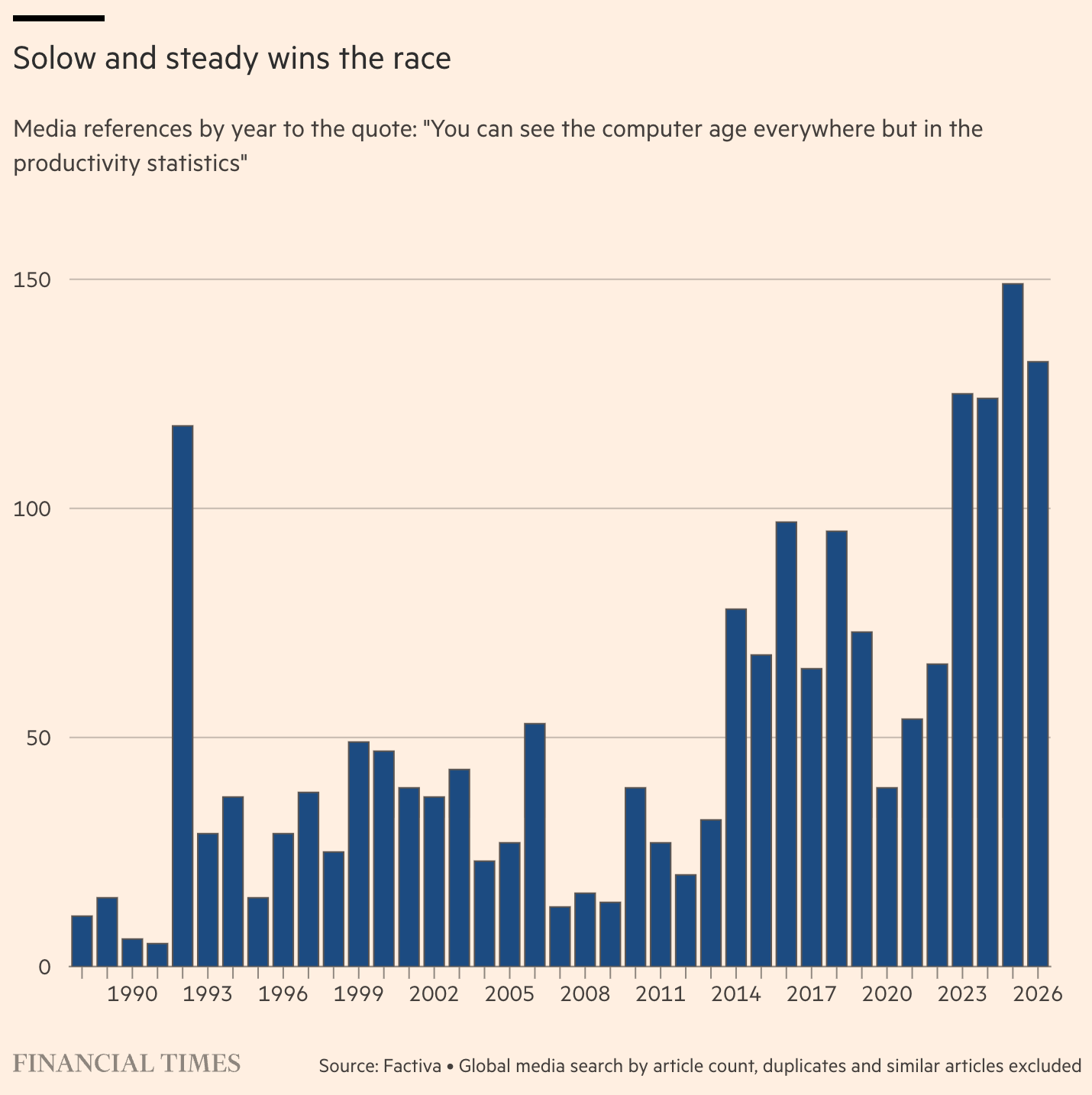
FT Alphaville with a terrific chart on the potential myth of AI-driven productivity gains:
 Is AI productivity growth in the room with us right now?ft.comThe fog of Warsh
Everything tagged #financial times
FT Alphaville with a terrific chart on the potential myth of AI-driven productivity gains:
Is AI productivity growth in the room with us right now?ft.comThe fog of WarshAcross the open-source ecosystem, AI code tools are disrupting a set of norms that has rewarded developers for building or contributing to software that benefits everyone. In the past, contributions to open-source projects were bullet points on a developer’s CV. But are you a contributor if your contribution was authored by Claude or Codex? And if the “community of users” for your project is increasingly made up of bots, will you still be motivated to build or maintain it? And if not, then what happens when we open the sink tap?
 Who cleans up after the vibe-coding party?ft.comOur obsession with AI code-writing tools is overwhelming the web’s unsung human caretakers
 Why are so many footballers wearing pink boots at the World Cup?ft.com (GIFT LINK)From Jude Bellingham to Kylian Mbappé, players are voting with their feet for this year’s colour — and challenging traditional ideas of masculinity
We've all noticed. Pink boots — or cleats, as Americans inexplicably call them — are all the rage at the 2026 World Cup. Of the 26 players in the England squad, the Financial Times tots up, 22 have worn pink boots during the competition. There's a few reasons. First up:
Much of the popularity is pragmatic. “Brands used bright pink because it creates maximum contrast against the green pitch,” explains Matt Powell, senior adviser at BCE consulting. In an era where millions of people watch games by looking to the palm of their hand as well as a TV or big screen, pink boots “boost broadcast visibility”.
But then, neon yellow or maybe bright blue boots would have the same effect, so why pink? Players are of course being paid many millions to wear them, but beyond that, there's a broader signal emerging from the traditionally "feminine" colour being readily embraced:
Pink became more prominent on luxury menswear catwalks in the 2010s, as designers sought to subvert rigid gender norms. Gentle shades of the hue — what would become known as “millennial pink” — appeared proudly on runways for brands such as Sacai and Robert Geller and in the wardrobes of male celebrities like Bad Bunny and Mac DeMarco, possibly looking to market themselves more softly for female audiences — and provoke questions around what masculine identities could look like.
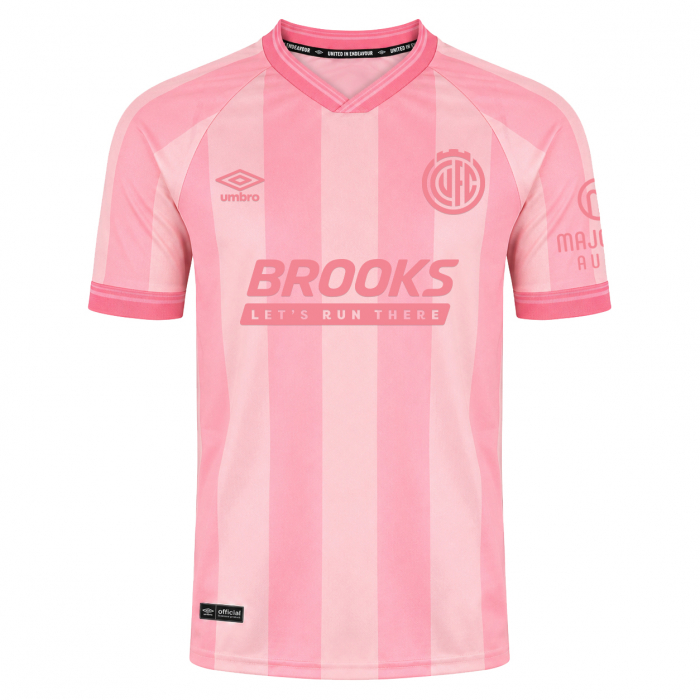
For this reason, expect more pink in football in the upcoming season, starting with my very own Cambridge United — the team's new third strip is positively on-trend:
What role for Britain in the AI revolution? Kanishka Narayan, the UK’s minister for AI and Online Safety, does a great job outlining both the country's vulnerability — no frontier LLMs to call its own — and its strength: more than a century of computing and AI innovation. Speaking to the Financial Times:
I think that the diagnosis has to be that we are not in a terrific position from a strategic leverage point of view. The frontier models are developed either in the United States or slightly behind them by a few months in China. And so Britain does not have companies when it comes to frontier language models, and we don’t have the core chip architecture, the Nvidia chips, as well as the memory and packaging.
So SK Hynix in South Korea, for example, gives them an advantage. TSMC in Taiwan gives them an advantage. ASML in Netherlands gives them an advantage. And so broadly speaking, we have some strengths in that supply chain, but none of those you would point to. Arm does a lot of the chip design, but none of those you’d really point to and say Britain is currently competing sufficiently with the United States and China so that we can have continued access to critical inputs.
And so the nature of the problem is very stark, and I think it’s a serious question for the future of our economic and national security. And so what do you do about it? And there are two ways I think about this. Broadly, what you’re trying to do is have, without the pun, chips on the table so that you can access others as critical inputs.
And you can do that either by having chips on the table in the AI stack, or you can also think about it as a broader international negotiation bundle. We might not just offer AI things, we might offer other things that are important to, say, the United States or to China to be able to secure access. On AI, what we’re trying to do is effectively say we think it’s really critical we build more leverage, and that’s why we are focused on things that give us leverage.
We think our chip companies will, if they succeed, be in a position where it’s very hard to replace them in some cases, and that gives you leverage. We think some of the frontier models that we’re developing outside of language in materials discovery, in new drugs discovery, in world models and vision models, we think those will give us leverage. But those are not overnight things, and they take a little bit of time.
And the third thing is, we have built pretty remarkable state capacity. We have built the AI Security Institute, which is the only lab in the world that gets pre-deployment access to all the core models. And so by understanding the risks, sharing it in a trusted way with core allies across the Five Eyes, we think we’re able to build trust that also gives us leverage in the AI stack as well.
And so my focus across the AI stack, both on hardware, on models, and at the heart of it on governance assurance, on safety, on state capacity, is to try and build things that serve British interests domestically as well as internationally.
 Transcript: How to win at AI (if you’re not the US or China), with AI minister Kanishka Narayanft.comSoumaya Keynes speaks to Kanishka Narayan