Dave Lee
My WorkBlogupdated 8 hours ago

Interesting links, noteworthy journalism and other miscellanea from around the web.

Be nice to your chatbot

Casey Newton:

Being polite to a large language model can feel strange or even silly — roughly equivalent to thanking a toaster. And yet a recent paper from Anthropic lends scientific weight to the theory that chatbots work better when you’re nice to them.

The researchers found that language models have fairly reliable internal representations of feelings like “happiness” and “distress,” and that these representations affect their behavior — sometimes for the worse. For example, when Claude Sonnet 4.5 begins to represent “desperation,” the model is more likely to cheat at coding tasks.

Read more: The scientific case for being nice to your chatbot

A "Banner" deal for local journalism

Some great news from the ailing world of local journalism. The Pittsburgh Post-Gazette is going to be saved by the parent company of the terrific Baltimore Banner:

The Venetoulis Institute for Local Journalism, which runs The Baltimore Banner and is financed by the hotel magnate Stewart W. Bainum Jr., said on Tuesday that it had reached an agreement with the newspaper’s current owner, Block Communications, to buy the assets of The Post-Gazette and run it as a nonprofit. The transaction is expected to take effect on May 4, ensuring there is no gap in publishing.

The deal is a rare spot of good news for the media industry, which has endured waves of metropolitan and local newspaper closures and widening local news deserts around the country for the past two decades. A 2025 report by Northwestern University found that more than 130 papers had shut in the preceding year alone.

Lately, it's seemed as if there's two kinds of sustainable media company. Huge -- the NYT, Bloomberg -- or extremely small, like the Substackers.

The Baltimore Banner is hope for a different way -- local news done well without all the overheads of the previous era: expensive executives and clueless publishers that drove those vital businesses into the ground.

Uncomfortably close to tragedy

Artemis was a triumph, writes Bloomberg Opinion's Timothy Lavin, but it might not have been. Sobering reading:

For all the well-earned acclaim, this mission was uncomfortably close to tragedy. In fact, its risks were more pronounced than the public was generally aware, and out of all proportion to the limited goals it was pursuing.

Dolly Parton's popularity

Dolly Parton is the most popular person in America, an (actually quite rigorous) poll finds:

Parton has a net favorability of +65, 50 points higher than Barack Obama (+14) or Volodymyr Zelensky (+13), and more than 60 points above the just-barely-positive Taylor Swift (+3). Of course this doesn’t directly translate to popularity; a T-Swift tour will outsell Parton 100 times out of 100. The poll suggests that though Swift may be a juggernaut, nearly as many people loathe her as like her. With Dolly, there’s love everywhere you look.

While it’s just one poll, UMass Lowell is a reputable pollster; Silver Bulletin gives them an A-. Dolly is included in the questions in part because she’s an example of a genuinely beloved figure, which is rare in these often less-than United States. She’s used as a bar that no politicians seem able to reach. Even Swift at +3 far outpaces most national figures in office.

We should never be drawn too much on this, obviously, but I do think it's notable how Dolly is, at the core of it, an unashamed and unequivocating liberal (or what American's consider "liberal," in our absurd times).

She was so pro-Covid vaccine she funded its development. On LGBT rights, she said "We are all god's children, we are who we are. We should be allowed to be who we are."

Has she spoken on all issues? No. But you couldn't accuse of her of not doing her bit to promote some sanity among the madness.

The end of the anecdotal lede

Former ProPublica president Richard Tofel declares the days of the "anecdotal lede" to be numbered. Among the reasons why, he says, is how AI might change our habits:

AI is another important factor pushing in the same direction. How much AI is going to take over news delivery is, I think, more of an open question than some techno-enthusiasts believe. But there is no real question that the degree to which content will come to us filtered through AI will grow substantially. And AI is simply going to strip away the grace (and, I am afraid, the power) of anecdotal ledes from those who insist on continuing to employ them. If you are summarizing a story, Kilgore’s nut graf survives—it even floats to the top. But the slow slide into the pool of the anecdotal lede is deemed surplusage.

"And not before time!" says a room of grumpy editors. (I'm not in that room.)

Tofel talks about the bulleted AI-generated summaries many news orgs (including the one I work for) are placing on top of stories these days. Why have this and then drop into an anecdotal lede? It's a good point. But I'm not giving up the right to an anecdotal lede that easily. I have two simple rules. First, the anecdote needs to be extremely relevant to the story at hand. Second, the anecdote needs to actually be good.

Threatening the Church

Christopher Hale in his 'Letters from Leo' newsletter:

In January, behind closed doors at the Pentagon, Under Secretary of War for Policy Elbridge Colby summoned Cardinal Christophe Pierre — Pope Leo XIV’s then-ambassador to the United States — and delivered a lecture.

“America,” Colby and his colleagues told the cardinal, “has the military power to do whatever it wants in the world. The Catholic Church had better take its side.”

Read it all: The Pentagon Threatened Pope Leo XIV’s Ambassador With the Avignon Papacy

One word a minute

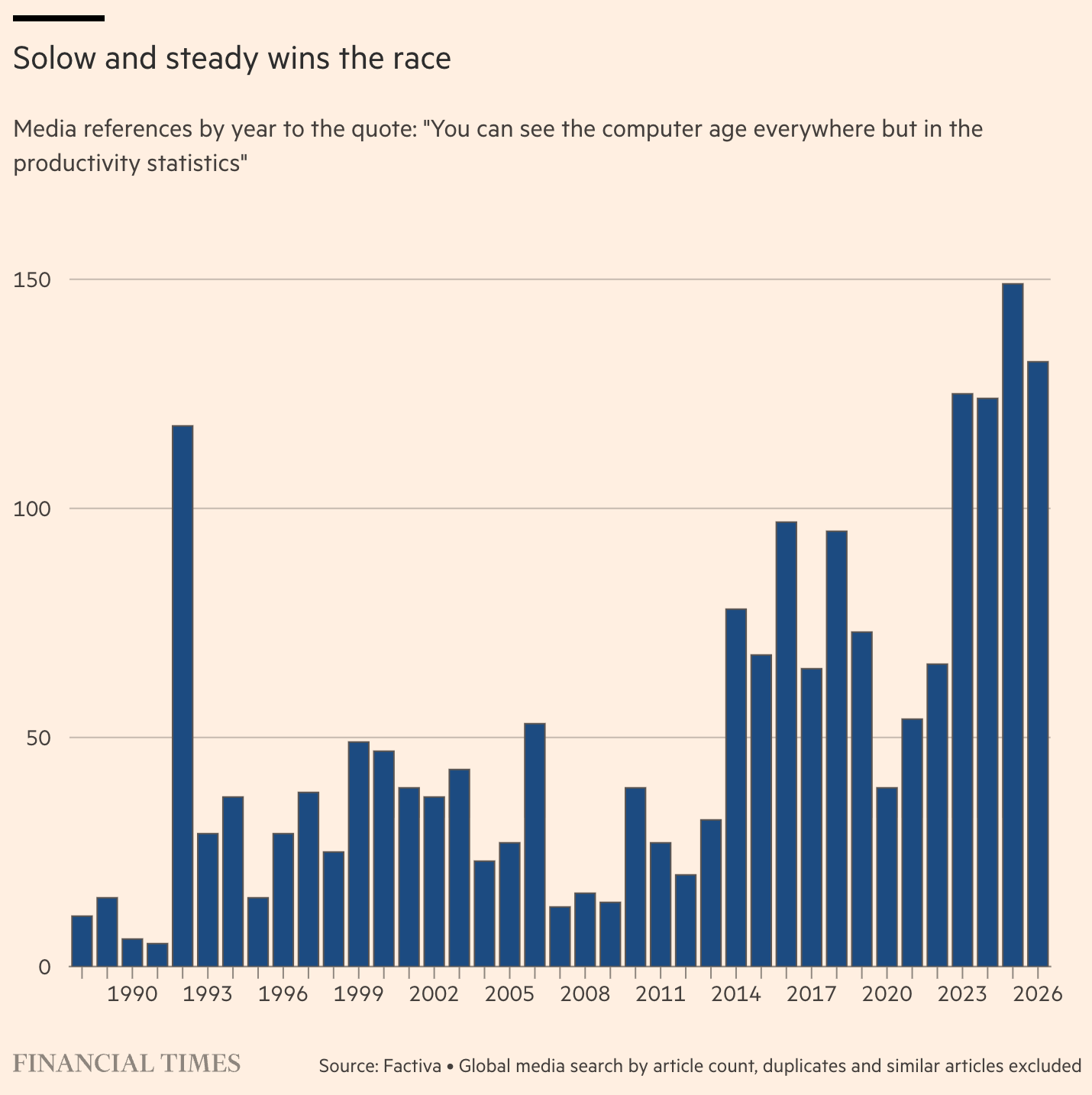
This 2,800-word essay took me 45 hours to write. I wrote it from scratch five times, and only 10% of my words made the final cut. That comes out to an average pace of one word per minute; imagine typing a single word, taking a brief walk, and then coming back to type the next. Writing happens at an unbearably slow pace for a culture that’s glued to vertical feeds with split-second reward loops, but thinking takes time. Good thinking takes a lot of time and even more toil. Essay writing is a process I’ve grown to love, a process I believe is deeply human, and yet it’s a process that’s becoming endangered.

-- Michael Dean: Essay Writing as Personal Sovereignty

The simple North Korean test

Facing a problem of North Koreans posing as different nationalities for remote jobs, one tech start-up implements a simple test: Will they insult Kim Jong-Un?

TechCrunch has more on the practice here.

Bluesky isn't growing

James Ball on Bluesky's (lack of) growing pains:

This is the better question about this stuff: most of us aren’t technology investors. We just want a social network we can use, and which ideally isn’t full of fascists, trolls, and bots. Bluesky’s small size can feel like a bonus against that backdrop: for many of its current users, the network feels fine as it is. Why worry about it growing? I’m getting what I need from it now.

The problem is monetisation: Bluesky costs a lot of money to run, and at present the bills are being paid by investors. They don’t do this out of the goodness of their hearts. They do so in the hope of making vastly more money later. Generally, investors will be happy to subsidise the losses of a company if it is growing, especially if it is growing fast.

A clear violation

A note attached to a New York Times book review:

Editors’ Note: March 30, 2026:

A reader recently alerted The Times that this review included language and details similar to those in a review of the same book published in The Guardian. We spoke to the author of this piece, a freelancer reviewer, who told us he used an A.I. tool that incorporated material from the Guardian review into his draft, which he failed to identify and remove. His reliance on A.I. and his use of unattributed work by another writer are a clear violation of The Times’s standards. The reviewer said he had not used A.I. in his previous reviews for The Times, and we have found no issues in those pieces. The Guardian review of “Watching Over Her” can be read here.

You can't defeat the robots

Minnesota Twins manager Derek Shelton becomes to the first to be ejected from the game for becoming infuriated at the decision of the robot umpire.

This season, which started this weekend, is the first to include the controversial technology.

The commentator's call is pretty special:

We would use different words

Colby Hall in Mediaite on how we've stopped being stunned by the batshit cabinet meetings hosted by President Trump, one of which was held on Thursday and lasted 98 minutes. Hall:

Here’s what I keep coming back to: if a transcript from this meeting came from the government of Brazil — or Hungary, or any country we cover from a comfortable critical distance — we would not file it as a cabinet meeting. We would write about it as a document. We would ask what it reveals about the man producing it and the institution that has formed around him. We would use different words.

But we don’t use different words for Trump. We stopped a long time ago, so gradually that I’m not sure anyone made a conscious decision to stop. It just became the way the job gets done.

And I say “we” deliberately, because Mediaite runs the clips too. We package the highlights. We write the posts. I’ve written more of them than I care to admit, and I’ll probably write more, as the traffic they generate is part of what keeps the lights on here. So I’m not throwing stones from outside the house. I live in this house. That’s actually why it bothers me.

Greenland sharks

Katherine Rundell:

In​ 1606 a devastating pestilence swept through London; the dying were boarded up in their homes with their families, and a decree went out that the theatres, the bear-baiting yards and the brothels be closed. It was then that Shakespeare wrote one of his very few references to the plague, catching at our precarity: ‘The dead man’s knell/Is there scarce asked for who, and good men’s lives/Expire before the flowers in their caps/Dying or ere they sicken.’ As he wrote, a Greenland shark who is still alive today swam untroubled through the waters of the northern seas. Its parents would have been old enough to have lived alongside Dante; its great-great-grandparents alongside Julius Caesar. For thousands of years Greenland sharks have swum in silence, as above them the world has burned, rebuilt, burned again.